
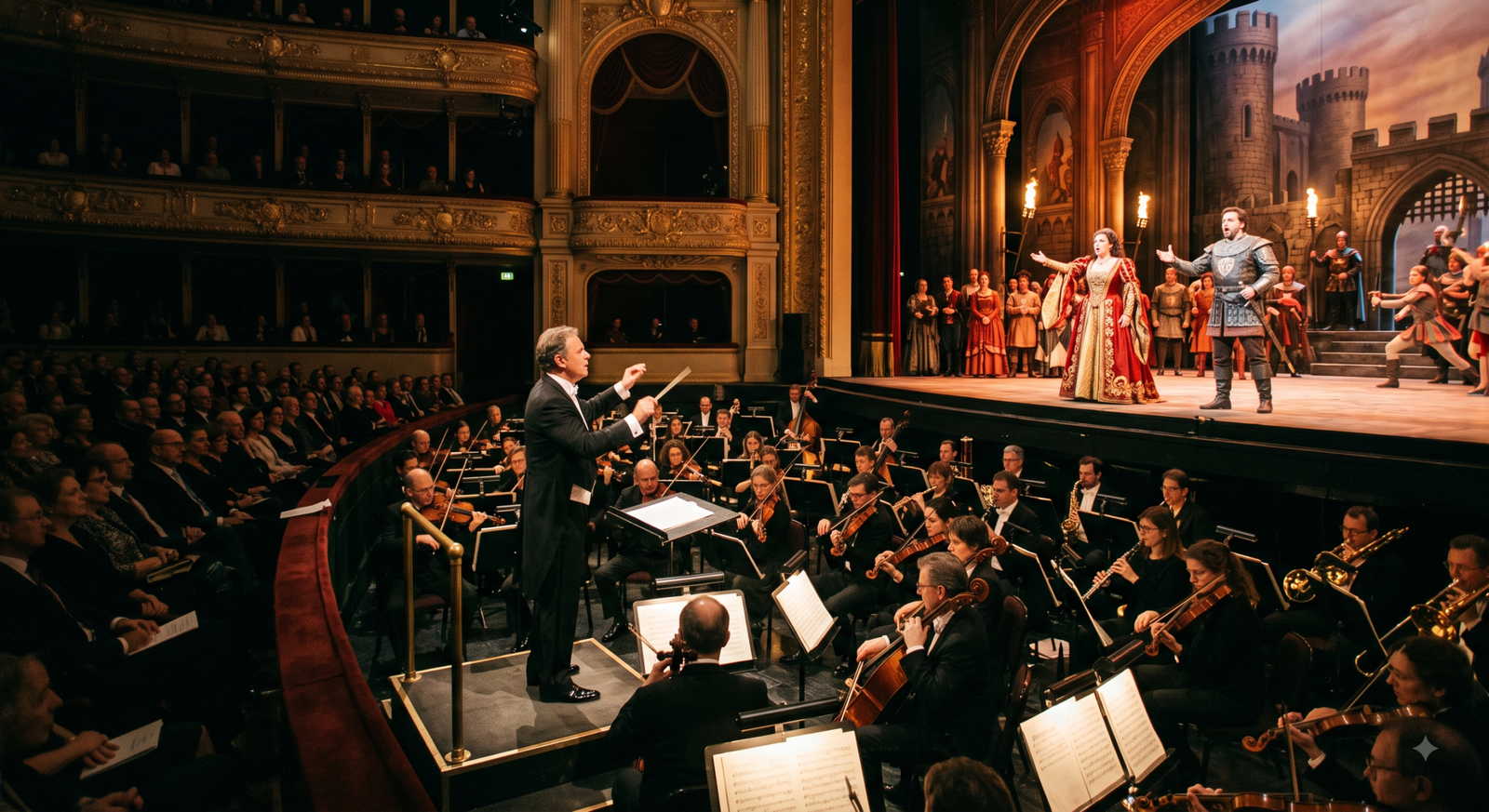
If you’re new to opera, watching a performance for the first time can sometimes feel like being dropped into the middle of a conversation.
The orchestra begins. A singer appears. Then another joins them. The music changes. Someone sings a long, beautiful passage. Suddenly the entire cast is on stage.
What exactly is happening?
The good news is that opera has a structure. Once you understand the basic pieces, following a performance becomes much easier—and much more enjoyable.
An opera isn’t simply a long sequence of songs. It is a carefully constructed combination of orchestral music, solo singing, dialogue-like passages, ensembles, choruses and dramatic scenes.
Let’s take a look at how it all fits together.
What Is an Opera Made Of?
Most operas contain some combination of:
- An overture or orchestral introduction
- Recitative
- Arias
- Duets
- Ensembles
- Choruses
- Orchestral interludes
- Acts and scenes
- Intermissions
- A finale
Not every opera uses all of these elements in exactly the same way. Opera has changed enormously over the centuries, so the structure of a Mozart opera can feel quite different from a Wagner or Puccini opera.
But these basic terms will give you a useful map.
What Is an Overture?
An overture is an orchestral introduction that takes place before the singers appear.
It can establish the mood of the opera and sometimes introduce musical ideas that will return later.
Mozart’s The Marriage of Figaro begins with a famous, energetic overture that immediately creates a sense of movement and comedy.
Rossini’s overtures are also particularly well known.
An overture isn’t always present. Some operas begin directly with the action, while others use a shorter orchestral introduction.
What Is Recitative?
Recitative is one of the elements that can initially seem strange to newcomers.
It sits somewhere between singing and speaking.
The singer delivers words in a rhythm that follows the natural flow of speech, usually with relatively simple musical accompaniment.
Its main purpose is often to move the story forward.
Think of it as the part of a film where characters have a conversation, except that in opera the conversation is sung.
Recitative is especially important in many Baroque and Classical operas.
What Is an Aria?
An aria is a solo vocal piece in which a character expresses an emotion, thought or important realization.
If you’ve ever heard a famous opera song performed outside the theater, there’s a good chance it was an aria.
Some famous examples include:
- “Nessun dorma” from Turandot
- “O mio babbino caro” from Gianni Schicchi
- “La donna è mobile” from Rigoletto
- “Vissi d’arte” from Tosca
An aria often slows the dramatic action down.
Instead of asking, “What happens next?” the opera pauses and asks, “How does this character feel about what is happening?”
That emotional pause is one of opera’s greatest strengths.
What Is a Duet?
A duet is a musical passage for two singers.
It might involve lovers, enemies, friends, family members or two characters trying to achieve completely different things.
Unlike an aria, which gives one character the spotlight, a duet allows two characters to interact musically.
Sometimes they sing together.
Sometimes they answer one another.
Sometimes they sing completely different melodies at the same time.
That musical interaction can reveal relationships in ways ordinary dialogue cannot.
What Is an Ensemble?
When three or more singers perform together, you’re generally entering the world of an ensemble.
These scenes can become wonderfully complicated.
Several characters may be experiencing different emotions simultaneously, yet the composer allows the audience to hear those conflicting feelings at once.
Mozart was particularly skilled at this technique.
In a great ensemble, you may have one character singing about love, another expressing anger and another trying to escape—all while the music somehow holds everything together.
What Is a Chorus?
The chorus represents a group of people within the world of the opera.
They might be:
- Citizens
- Soldiers
- Villagers
- Priests
- Courtiers
- Sailors
- Guests
The chorus can provide atmosphere, comment on events or become an active part of the story.
Some of opera’s most famous moments involve huge choruses.
Verdi’s Nabucco, for example, contains the famous “Va, pensiero,” while Aida includes some of the grandest crowd scenes in the repertoire.
What Are Acts?
An opera is usually divided into acts.
An act is a major section of the drama, similar to an act in a play.
Older operas often have several acts, while some modern works may be written as a single continuous piece.
The end of an act frequently provides a natural pause in the story.
That’s where you may find an intermission.
What Are Scenes?
Within an act, the opera may be divided into scenes.
A scene can change when:
- The location changes
- The characters on stage change significantly
- A new dramatic situation begins
The exact definition varies depending on the opera and its historical period.
You don’t need to worry too much about identifying every scene during your first performance.
The important thing is understanding that acts are larger dramatic sections and scenes are smaller units within them.
What Happens During an Intermission?
An intermission is a break between sections of the performance.
Depending on the opera, there may be one or more intermissions.
This is your chance to:
- Stretch your legs
- Get a drink
- Visit the restroom
- Read the program
- Talk about what you’ve just seen
Intermission also gives you a chance to remind yourself where the story is going.
If you’re attending your first opera, don’t be surprised if the audience suddenly becomes very animated during intermission. Discussing the performance is part of the fun.
What Is an Orchestral Interlude?
Sometimes the singers leave the stage while the orchestra continues playing.
This can be called an orchestral interlude.
It may connect two scenes, establish a new setting or allow the orchestra to express something that doesn’t need words.
In some operas, these passages are among the most memorable parts of the entire work.
Puccini, in particular, used the orchestra very effectively to connect dramatic moments.
What Is a Finale?
A finale is a concluding section of an act or the opera itself.
An act finale can bring several characters together and dramatically raise the tension.
The final moments of the entire opera usually provide some form of resolution—or, in tragic works, the absence of one.
A powerful finale can leave an audience completely silent for a moment before the applause begins.
How Does Everything Fit Together?
A simplified opera might look something like this:
Overture → Recitative → Aria → Recitative → Duet → Ensemble → Chorus → Finale → Intermission → Next Act
But don’t expect every opera to follow that exact formula.
Some works move freely between these forms.
Others deliberately abandon traditional structures altogether.
Opera is an art form that has constantly evolved.
Opera Structure Has Changed Over Time
This is important to remember.
An opera written in 1700 doesn’t necessarily behave like an opera written in 1900.
Baroque opera often gives considerable space to recitative and elaborate arias.
Classical composers such as Mozart developed ensembles and dramatic continuity in sophisticated ways.
Romantic composers increasingly blurred the boundaries between individual musical numbers.
By the time you reach Wagner, the distinction between aria and recitative can become much less obvious.
Later composers went even further.
So there isn’t one universal blueprint for opera.
Do You Need to Know All of This Before Watching?
Absolutely not.
These terms are useful because they help you understand what you’re hearing, but don’t turn your first opera into a vocabulary exam.
You don’t need to sit there thinking:
“That was definitely a recitative followed by a cabaletta.”
Just enjoy the performance.
As you watch more opera, the terminology will become familiar naturally.
A Simple Way to Follow Your First Opera
Before the performance, learn three things:
Who are the main characters?
What do they want?
What stands in their way?
Once you understand those three things, the music and staging become much easier to follow.
The technical structure is useful, but the story is what keeps you emotionally invested.
Final Thoughts
Understanding the structure of an opera takes away much of the mystery surrounding the art form.
Once you know what an aria, recitative, duet, ensemble, chorus, act and finale are, you’ll begin noticing how composers use each element to tell a story.
But don’t let terminology get in the way of enjoyment.
Opera isn’t a lesson you have to pass.
It’s a performance you get to experience.
The more you listen, the more naturally the structure will reveal itself.
Frequently Asked Questions
How many acts does an opera have?
There is no fixed number. Operas can have one, two, three, four or even five acts, depending on the work.
What is the difference between an aria and a recitative?
An aria generally focuses on a character’s emotions or thoughts, while recitative is more speech-like and is often used to move the story forward.
What is an opera finale?
A finale is a concluding musical section, either at the end of an act or at the end of the entire opera.
Does every opera have an overture?
No. Some operas begin with an orchestral introduction, while others begin directly with the dramatic action.
What is the chorus in an opera?
The chorus is a group of singers representing people within the story, such as citizens, soldiers, villagers or priests.
Internal Linking Checklist
✅ Link now
- What Is Opera? A Complete Beginner’s Guide
- How to Watch an Opera for the First Time
- Understanding the Different Opera Voice Types
⏳ Link later
- Opera vs. Musical Theatre
- How Long Does an Opera Usually Last?
- Why Is Opera Sung Instead of Spoken?
- Common Opera Terms Every Beginner Should Know
- Beginner’s Guide to Mozart Operas
- Beginner’s Guide to Verdi Operas
- Beginner’s Guide to Puccini Operas
- Famous Opera Arias
🔄 Update previous articles
Article #1: Link “basic structure of an opera” from the section explaining what makes an opera.
Article #2: Add this article where we discuss understanding the performance before attending.
Article #3: Link to this article from the section explaining why different voice types matter within an opera.
6 thoughts on “The Basic Structure of an Opera Explained”