
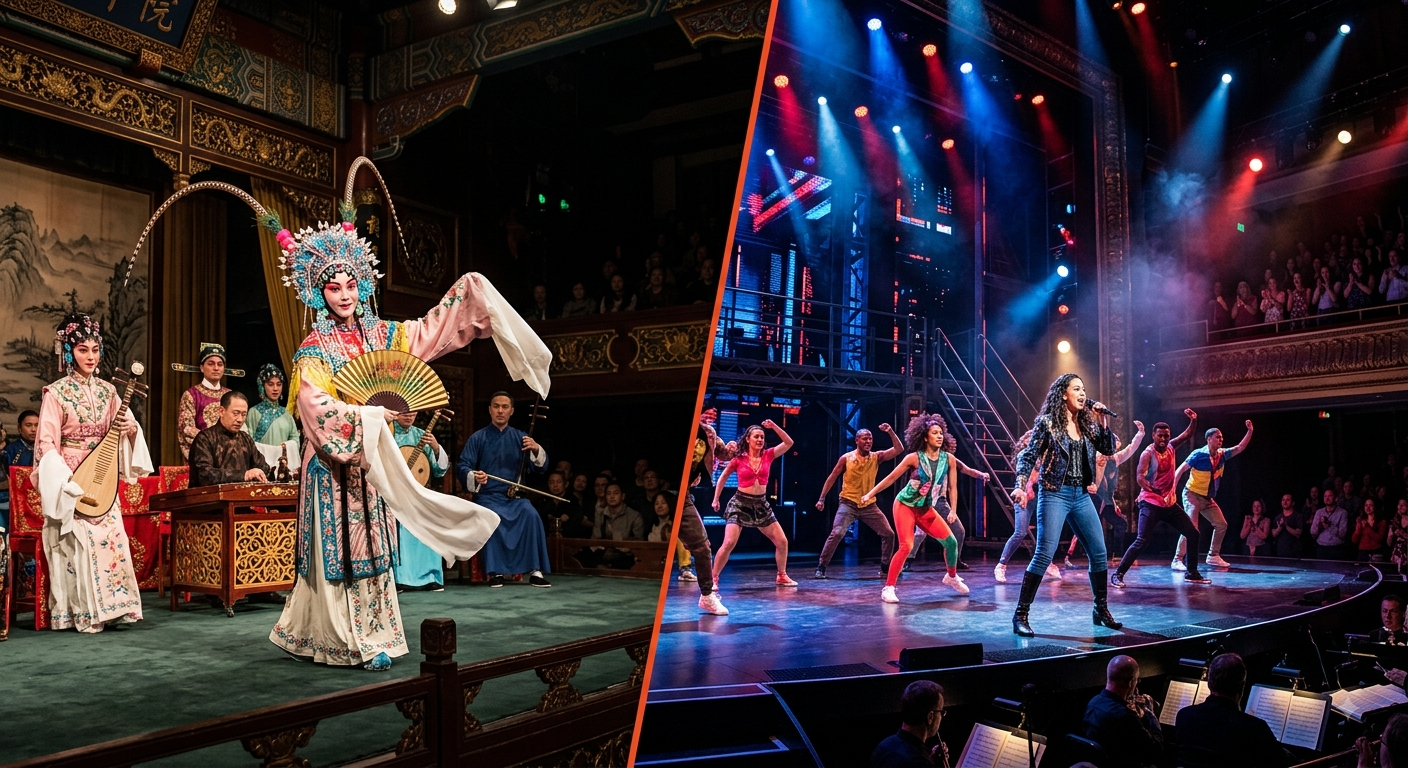
At first glance, opera and musical theatre seem remarkably similar.
Both tell stories through music. Both feature singers and actors. Both use costumes, scenery, choreography and lighting. Both can make audiences laugh, cry or sit on the edge of their seats.
So what actually separates them?
The answer isn’t as simple as saying, “Opera is sung and musicals are spoken.”
There are plenty of exceptions.
Modern musical theatre can contain extended sung passages, while opera can include spoken dialogue. The boundary between the two has also become increasingly fluid over time.
Still, there are some important differences that help explain why we generally classify a work as an opera or a musical.
Opera Is Primarily a Sung Art Form
Traditional opera is overwhelmingly sung.
The dialogue, emotions and dramatic action are usually carried through music rather than ordinary speech.
Musical theatre, on the other hand, commonly alternates between:
- Spoken dialogue
- Songs
- Dance
- Ensemble numbers
A musical may have long stretches of ordinary conversation before suddenly breaking into song.
Opera generally integrates singing much more continuously into the drama.
The Voice Is Treated Differently
This is one of the clearest distinctions.
Opera singers traditionally train to project their voices over an orchestra without microphones.
Their technique is designed for acoustic projection in large theaters.
Musical theatre singers often use microphones and can therefore employ a much wider variety of vocal styles.
They might sing in a conversational voice, belt, whisper or use contemporary pop techniques.
Neither approach is inherently better.
They’re simply designed for different theatrical traditions.
The Orchestra Is Different
Opera traditionally uses a live orchestra with a substantial instrumental section.
The orchestra doesn’t simply accompany the singers.
It can establish characters, create atmosphere, foreshadow events and carry emotional meaning.
Musicals can also use full orchestras, but modern productions frequently use smaller ensembles or electronically amplified instruments.
The musical’s sound world may also draw heavily from jazz, rock, pop, folk or other contemporary styles.
Opera Often Uses a Libretto
The written text of an opera is called a libretto.
It contains the words sung by the performers and the dramatic structure of the work.
Musicals also have scripts and song lyrics, but the terminology and writing process are different.
The librettist and composer traditionally collaborate to create an opera in which music and words function together.
Opera Can Be Much Older
Opera emerged in Italy around 1600.
Musical theatre developed much later from a mixture of theatrical and musical traditions.
That doesn’t mean opera is simply “older musical theatre.”
The two developed through different historical paths.
Opera grew from European court entertainment, theater, music and attempts to recreate aspects of ancient drama.
Musical theatre developed through traditions including operetta, vaudeville, popular song, dance and spoken theater.
But There Is a Lot of Overlap
Here’s where things become interesting.
Works such as West Side Story, Sweeney Todd and Show Boat contain serious dramatic writing and sophisticated musical structures.
At the same time, operas such as Mozart’s The Magic Flute contain spoken dialogue.
There are also works that deliberately sit between categories.
So rather than thinking of opera and musical theatre as two completely separate boxes, it can be more useful to think of them as neighboring theatrical traditions.
What About Operettas?
Operetta occupies another fascinating position between opera and musical theatre.
Operettas tend to combine singing with spoken dialogue and often have lighter, more accessible stories.
Works by Johann Strauss II, Gilbert and Sullivan and Jacques Offenbach are frequently discussed in this context.
Understanding operetta helps explain why the boundary between opera and musical theatre has never been completely rigid.
Are Opera Stories More Serious?
Not necessarily.
This is another common misconception.
Opera includes enormous tragedies, but it also contains some wonderfully funny comedies.
Mozart’s The Marriage of Figaro is full of misunderstandings and comic situations.
Rossini’s The Barber of Seville is energetic, playful and genuinely funny.
Opera can be dark, ridiculous, romantic, political, absurd or heartbreaking.
Just like musical theatre.
Why Do Opera Singers Sing So Loudly?
Opera developed before modern amplification.
A singer needed to project over an orchestra and reach an audience in a large theater.
That led to specialized vocal techniques emphasizing resonance and projection.
Modern opera houses are designed acoustically to help those voices carry.
Musical theatre, by contrast, developed in an era where electronic amplification became increasingly important.
Do Opera Singers Act?
Absolutely.
The idea that opera singers simply stand in one place and sing is outdated.
Modern opera productions can involve:
- Complex choreography
- Physical acting
- Elaborate movement
- Dance
- Fight scenes
- Intimate interactions
- Highly detailed character work
The best opera singers are not simply great voices.
They’re compelling performers.
Which Is Easier for Beginners?
That depends entirely on the person.
Someone who enjoys classical music may find opera immediately accessible.
Someone accustomed to contemporary theater may find a musical more familiar.
The good news is that enjoying one doesn’t prevent you from enjoying the other.
If you love Les Misérables, you may eventually discover Verdi.
If you love La Bohème, you may find yourself enjoying Rent, which was inspired by it.
The connections between the traditions can be fascinating.
Can Opera Fans Enjoy Musicals?
Of course.
In fact, there are countless connections between the two worlds.
Some composers, singers and directors have worked across both traditions.
Musical theatre has also borrowed ideas from opera for generations.
And opera companies increasingly stage works that challenge traditional definitions of the art form.
Final Thoughts
Opera and musical theatre aren’t rivals.
They’re two extraordinary ways of combining music, theater and storytelling.
Opera traditionally places greater emphasis on continuous singing, classical vocal technique and orchestral writing, while musical theatre often combines spoken dialogue, contemporary vocal styles, choreography and amplified sound.
But the boundaries aren’t absolute.
If you love one, there’s a good chance you’ll find something to enjoy in the other.
And if you’re just beginning your journey into opera, don’t worry about choosing sides.
There’s plenty of room for both.
Frequently Asked Questions
Is opera the same as musical theatre?
No. They share many characteristics, but traditional opera is primarily sung and uses classical vocal techniques, while musical theatre commonly combines spoken dialogue, singing and dance.
Are opera singers louder than musical theatre singers?
Opera singers traditionally project acoustically without microphones, while musical theatre singers usually perform with amplification.
Can an opera contain spoken dialogue?
Yes. Some operas, including The Magic Flute, use spoken dialogue.
Is musical theatre based on opera?
Musical theatre developed from several theatrical and musical traditions. Opera is one important part of the broader history of musical storytelling, but musicals are not simply modern operas.
What is operetta?
Operetta is a lighter theatrical form that commonly combines singing with spoken dialogue and sits historically between opera and later musical theatre traditions.
Internal Linking Checklist
- What Is Opera? A Complete Beginner’s Guide
- How to Watch an Opera for the First Time
- The Basic Structure of an Opera Explained
⏳ Link later
- Why Is Opera Sung Instead of Spoken?
- How Long Does an Opera Usually Last?
- The Magic Flute: A Complete Guide
- The History of Opera
- Beginner’s Guide to Mozart Operas
- Beginner’s Guide to Verdi Operas
🔄 Update previous articles
Article #1: Add a link where we discuss how opera differs from other forms of entertainment.
Article #2: Add a link in the section about choosing your first opera, especially if readers are coming from musical theatre.
Article #4: Add a link in the conclusion or introduction where we discuss how opera’s structure differs from other theatrical forms.
3 thoughts on “Opera vs. Musical Theatre: What’s the Difference?”